- Byline: the author as production credits him ("By Ben Espach"). Production says "Last updated: Jul 6, 2026"; the rewrite is dated 7 Oct 2026. The reading time is estimated from the word count.
- The pill merges production's two tags ("Compliance" and "Software recovery") into the one a reader scans for.
- The narrative: the article now walks the arc. The exposure (an exit plan nobody has tested), the shift (a filed plan isn't a tested one), the model and the proof (what each protection adds to the file), then the next step.
- Old names out: production presents "Codekeeper's Certified verification tier" as the answer. That's replaced by the proof ladder: Agentic Verification and the Recoverability Certificate, and the Exit Exercise for a human-run test.
- Fear lines out: "That assumption is a trap", "intent has never kept a single critical system running" and "Most teams don't know where they'd actually stand if a critical vendor failed next week" are rewritten or cut.
- Hero CTAs: Book a demo and Get the sample evidence pack, as on every page. The guide band further down is this page's own offer.
DORA Article 28 exit strategies: what financial entities need to build.
Article 28(8) asks for exit plans that are documented and sufficiently tested. Here's what a tested exit strategy covers, what to keep on file, and how to tell whether your plan has ever been put to the test.
- Regulation: the Article 28(8) quote is the verified string in MESSAGING.md §7, with the disclaimer under it. The Article 4(2) sentence is a label, not a quote: its opening ("shall be proportionate to their size…") was read on EUR-Lex. Legal should review both before launch.
- Not kept: production's claim that an exit strategy "breaks down into four components under Article 28". We couldn't read the rest of Article 28(8) on EUR-Lex from here, so the four parts are presented as practice, not as the regulation's list. Also cut: "their contracts will need to secure termination rights, the return of code and data, and active exit support" (a contractual reading of DORA we couldn't verify) and "The regulation calls for tested recovery evidence to ensure one firm losing a critical provider won't cascade that damage" (a statement of the law's purpose with no source).
- Facts used (MESSAGING.md §6): four rebuilds a year in the Pro levels (Escrow Pro, Resilience Pro, Continuity Pro), the Codekeeper AI Verification Lab, no vendor help, hours not weeks, monitoring between runs, the Exit Exercise and its report, the certificate line on release rights, and our DORA level guidance from dora.html. "Deposits sync daily" is a production claim still on to-confirm.md.
- 16 Oct: Continuity Pro added; base Continuity no longer includes Agentic Verification, so every rebuild mention, the evidence map and the level guidance name Continuity Pro.
- Links kept: the four production articles the original links to, and the risk assessment (now risk-assessment.html). Production's "keeps financial service providers compliant" link text is reworded. Those four articles haven't been rewritten yet, so they move up the rewrite list.
- Image: production's cover, "DORA Exit Plan.png" (described in its metadata as "A team assessing their DORA exit plan"). Check it shows no old tiers or medals before launch.
Most teams working towards DORA have an exit strategy on file. It names their critical providers, describes how the firm would move off each one, and sits ready for the next review. Article 28 asks a different question: would the plan work if you had to use it?

A plan that has been written down but never tested describes an intention. This article covers what Article 28 expects, why a documented plan and a tested plan aren't the same thing, what a tested exit strategy covers, and the evidence that shows yours has been tested.
What Article 28 asks of you
Article 28 of the Digital Operational Resilience Act (DORA) sets out how financial entities manage the risk that comes from their ICT third-party service providers. The exit strategy obligation is narrower than many teams assume. It applies to ICT services that support critical or important functions, not to every supplier you use. So the first job is knowing which of your providers fall inside that scope.
For those that do, paragraph 8 sets the standard for exit plans.
“Exit plans shall be comprehensive, documented and, in accordance with the criteria set out in Article 4(2), shall be sufficiently tested and reviewed periodically.”
Codekeeper's evidence supports your assessment. Whether it meets a specific requirement is for you and your assessor to decide.
That's four requirements: comprehensive, documented, sufficiently tested and reviewed periodically. Three of them can be met on paper. "Sufficiently tested" can't. It asks for evidence that something was done, and that's where most exit programmes have the least to show.
The standard is also proportionate. The paragraph points to the criteria in Article 4(2), which apply the rules in proportion to a firm's size and risk profile. A small payment institution and a large bank aren't expected to test to the same depth.
A filed plan and a tested plan
A plan describes what you intend to do. It might say: if this provider fails, we'll retrieve the source code, stand it up on other infrastructure and migrate our data within 90 days. Every part of that sentence is a claim.
A tested plan is what you have once someone has checked those claims. When the software has been rebuilt from what you hold, you know whether 90 days was realistic, and what was missing.
That's the difference a reviewer looks for. A plan shows intent. A dated test result shows capability. Article 28(8) asks for both.
For the wider exercise, step by step, see our guide to software vendor exit planning.
What a tested exit strategy covers
If testing is what separates a working exit strategy from a written one, the next question is what to test. In practice, an exit plan for a critical ICT provider comes down to four working parts. Going through them is the quickest way to see where your programme is solid and where it needs work.
1. A transition plan
The documented sequence for moving off the provider, with timelines. The timelines have to hold up under adverse conditions. A migration that takes three weeks when everyone cooperates can take three months when the vendor is insolvent and unresponsive. Done means the timeline has been checked against the difficult version of events, not the tidy one.
2. Data portability
A confirmed ability to extract your data in a usable format when the contract ends. "Usable" is the word that matters: data you can export but can't read, reload or work with isn't portable. Done means an extraction you've opened and worked with.
3. An alternative
For each critical relationship, at least one alternative you could move to: another provider, or bringing the service in-house. Naming one is easy. Done means an option you've assessed for the specific function it would take over.
4. Periodic testing
The part that turns the other three from claims into evidence. It means running the recovery on a cadence that matches the risk, and again when something significant changes, and keeping a record of the result. Done means proof that the materials were exercised and behaved as the plan said they would.
Where rebuild evidence fits
Of the four parts, the recovery itself is the hardest to evidence. You can write a transition plan and assess an alternative on your own. Showing that the materials you hold would rebuild into working software is a different task. It needs the deposit, a clean environment and someone who didn't write the code.
A deposit nobody has tried to rebuild is the document problem again, moved into a vault. Codekeeper's proof comes in three steps, and each one adds a different document to your file:
- Software Resilience Certificate, with every protection. The deposit is held, and an automated check, with a vault report, has confirmed what's in it.
- Recoverability Certificate, with Escrow Pro, Resilience Pro and Continuity Pro. Agentic Verification: AI agents rebuild the deposit in the Codekeeper AI Verification Lab, with no help from the vendor, in hours. The run also produces build steps, an SBOM, an Exit workbook and a deployable copy.
- Tested Exit Report, from an Exit Exercise, an add-on to any plan. Our specialists rebuild the application by hand in a clean room, from the deposit alone, and test the business functions you nominate, without the original developers. The report records pass or fail, the gaps found and the date, with an annex mapped to DORA.
Which proof you need depends on the function. For ICT services that support critical or important functions, our guidance is Resilience Pro or Continuity Pro, plus an Exit Exercise when the plan needs exercising, not just a rebuild. The DORA page maps each document to Article 28.
What to keep on file
The clearest way to find out whether your exit strategy is tested or only written is to assemble what a reviewer would ask to see, and check how much of it you can produce. If the plan document ends up standing in for several items, that's where to start. For one critical provider, the file usually holds:
| What the file needs | Codekeeper evidence |
|---|---|
| The agreement covering the relationship | Escrow AgreementResilience ArrangementEvery protection. It names what's deposited and what happens when it's needed. |
| Proof the deposit is held and current | Software Resilience CertificateVault reportEvery protection. Deposits sync daily through integrations, and an automated check confirms what's in them. |
| Proof the software rebuilds without the vendor | Recoverability CertificateRun reportSBOMEscrow Pro, Resilience Pro and Continuity Pro. A rebuild by AI agents in the Codekeeper AI Verification Lab. |
| A transition plan you can follow | Exit workbookBuild stepsEscrow Pro, Resilience Pro and Continuity Pro. The recovery process step by step. Your own plan adds the owners and timelines. |
| A record of the most recent exit test | Tested Exit ReportDORA annexExit Exercise, an add-on to any plan. Pass or fail per function, the gaps and the date. |
Only the agreement and the plan are documents in the ordinary sense. The rest are records of things having been done, which is what makes the file hard to keep whole. A certificate from last year doesn't show that this year's deposit still builds, so the evidence has to be refreshed as the software changes.
Not sure which providers need this? Learn how to assess your vendor risk and match the right protection to each one.
Common gaps
Check real exit programmes against that file and the same gaps come up. It's rarely a sign of a careless team. Most programmes were built to produce a document, not to show that the recovery works. The gaps tend to sit in a few places:
- An exit strategy that describes a process but never names the materials needed to carry it out.
- Source code in escrow that has never been rebuilt, so the deposit exists but nobody knows whether it builds.
- Annual reviews that update the wording of the plan without testing the recovery.
- No alternative identified for a critical ICT relationship.
- Transition timelines that have never been checked against a realistic failure.
Each gap is the same issue in a different form: a capability the programme describes but hasn't confirmed. Closing them isn't about writing more. It's about testing what's already written. For the wider picture, read our guide to managing vendor risk with software escrow.
A note for software vendors
If you sell software to EU financial entities, Article 28 reaches you too, from the other side. Your customers have to plan their exit from the ICT services they rely on, and yours may be one of them.
Expect their risk and procurement teams to ask how they would exit, and what would happen to the code and data if you couldn't support them. Escrow answers that before they ask. With Escrow Pro, you can also show them a Recoverability Certificate: proof the deposit builds without your help, so due diligence doesn't stall the deal. Read more on software escrow for financial services.
Test it before you need it
A review is one test of an exit plan. The other comes on the day a critical provider stops and you start the recovery. That's when it matters whether the materials you hold rebuild into working software.
Rebuild evidence answers that question in advance, on a schedule you choose, with a dated record for your file. To see where you stand first, the free risk assessment shows which providers carry the most risk.
Keep reading
Related reading.
DORA: your exit plan, tested and on file
The documents each protection adds to your Article 28 file, mapped row by row.
The Exit Exercise
A clean-room rebuild from the deposit alone, tested against the business functions you nominate.

Stressed exit testing: what it is, what it proves, and how to run one
A vendor exit plan on paper means little until you've proven it can work.
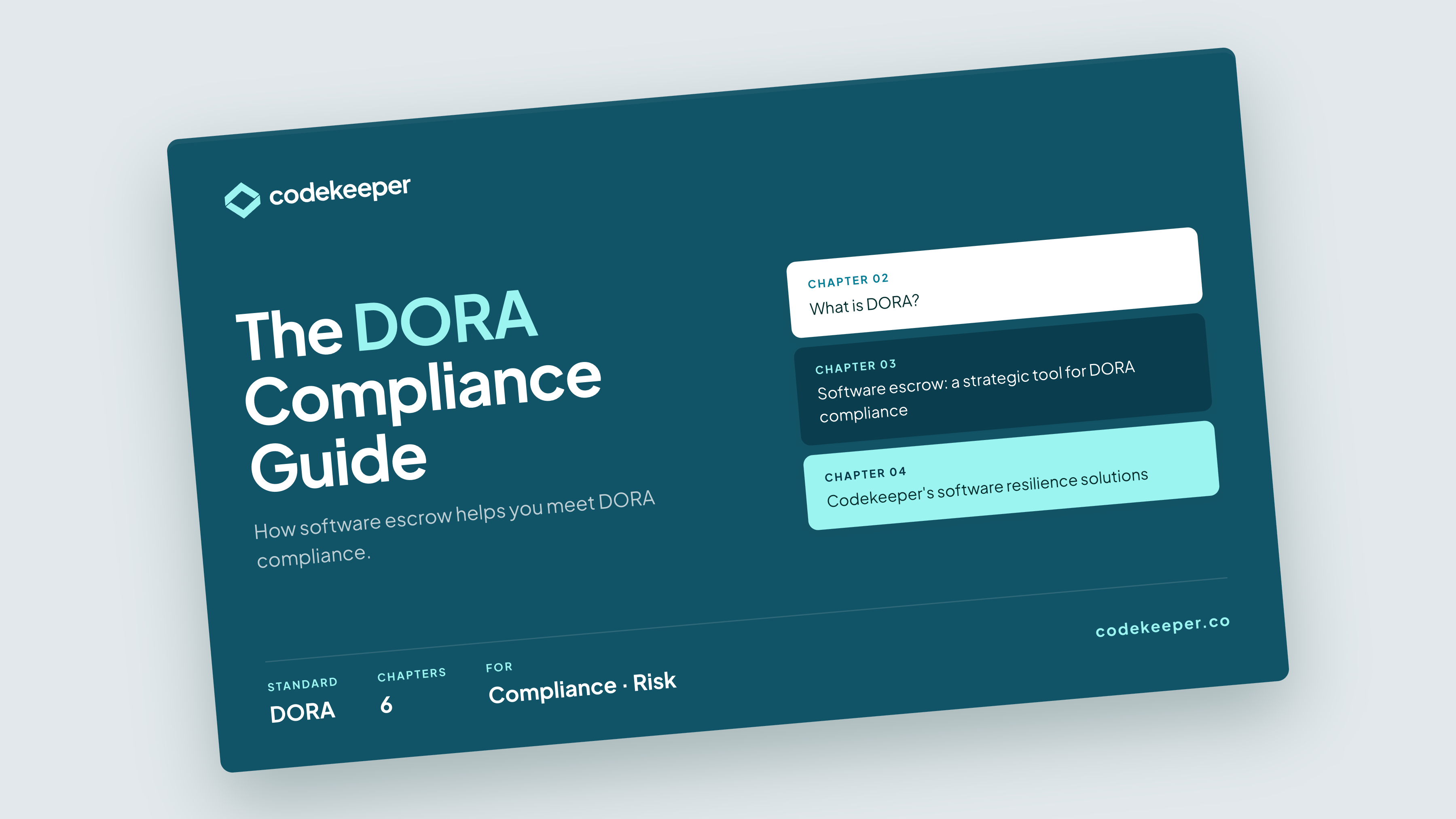
Free guide
The DORA Guide
What DORA asks of ICT third-party risk, with a closer look at the exit plans Article 28 asks for.
- The parts of DORA that touch your software suppliers
- What Article 28 asks of exit plans
- Evidence you can put in your file
Know your exit plan works before you need it.
We'll map your critical or important functions to the applications behind them, and the evidence each one needs.