- Why it matters (the exposure) and why having the code isn't the same as getting it back (the shift), as a long read with an "On this page" list.
- How it works with Codekeeper today: applications, then a protection, then a level. Software escrow is what we call Escrow (released to you); Resilience and Continuity go further.
- The proof ladder, then costs, a guide offer and the FAQ.
What is software escrow?
Software escrow is an agreement in which a software vendor deposits its source code, and everything needed to maintain the software, with a neutral third party. If an agreed release condition is met, such as the vendor's insolvency, the deposit is released to the customer, so the software can be maintained without the vendor.
- Trusted by 3,500+ teams
- ISO/IEC 27001:2022 certified
- Securing software since 2014
Trusted by 3,500+ teams, from regulated enterprises to fast-growing software vendors








Software escrow, defined
Software escrow puts what you'd need to maintain an application with a neutral party, under terms everyone agrees before anything goes wrong.
The software vendor, called the depositor, deposits the source code and the materials around it with an escrow agent. The agent holds the deposit for both sides and keeps it current. The agreement lists what's deposited and the conditions under which it's released. If one of those conditions is met, for example the vendor becomes insolvent or stops supporting the software, the deposit is released to the customer, called the beneficiary. The customer can then fix, change and move the software without the vendor.
Most escrow arrangements run quietly in the background for years. Their value is in being there, checked and current, on the day they're needed.
Who's involved
- Depositor
- The vendor that builds the software and makes the deposits.
- Beneficiary
- The customer that relies on the software and receives the deposit on release.
- Escrow agent
- The neutral party that holds and checks the deposit. At Codekeeper, that's us.
- The agreement
- Names the parties, the deposit and the release conditions. Two-party, three-party or multi-party.
The agreement can take three shapes. A two-party agreement runs between the vendor and Codekeeper, so protection can extend to any customer who asks. A three-party agreement also names one beneficiary, who signs too. A multi-party agreement names several beneficiaries, each with its own release conditions. How the agreement works
Related terms
- Source code escrow usually means the same thing. The name puts the code first, but a useful deposit holds more than code. What is source code escrow?
- SaaS escrow covers hosted applications, where the deposit also needs infrastructure, data and access. What is SaaS escrow?
- AI escrow covers AI systems: models, prompts, pipelines and workflows. What is AI escrow?
- Technology escrow and IP escrow are broader terms for assets beyond software, such as designs and algorithms.
Why it matters
Every business runs on software it didn't build. When a vendor fails, is acquired or simply stops, the software may keep running for a while. But bugs can't be fixed, changes can't be made and it can't be moved somewhere else. Starting again takes time and money that few teams have budgeted for.
The risks tend to fall into four groups:
- Failure. Insolvency, a takeover or a discontinued product ends support, often with little notice.
- Attack. Ransomware or a supply-chain attack takes the vendor's systems down, and with them its ability to support yours.
- Non-compliance. Auditors, clients and regulators ask how you would exit a critical supplier, and what proof you have.
- Broken. An update corrupts data or breaks a core function, and only the vendor's team can work on the code.
Escrow works for vendors too. Enterprise buyers, especially in regulated markets, often ask for it before they sign. An escrow arrangement answers the continuity question in due diligence, and the vendor's code stays private: it's released only under the agreed conditions.
Having the code isn't the same as getting it back
A deposit only helps if it's complete, current and usable. Code from two years ago, or code without the build scripts and dependencies that turn it into running software, is protected on paper only. Many teams find that out on the day they need it.
And someone has to do the work. With classic escrow, the deposit is released to you, and your team, or a partner you choose, runs the recovery. That suits teams who know the stack. Others need the recovery done for them, or need the live service to stay on while it happens.
How it works with Codekeeper
One account. A protection for each application.
Codekeeper organises escrow around the applications you can't lose. Add each application, attach the protection that matches what should happen when it fails, then choose the level.
Add the application
The vendor software your business depends on: on-premise, SaaS or AI. Prices are per application.
Attach a protection
Escrow releases the deposit to you. Resilience brings the application back for you. Continuity also keeps the live environment on while we recover.
Choose the level
Escrow is everything you need to be protected. Escrow Pro is everything you need to recover: it adds Agentic Verification.
Escrow
Released to you→Self-Run Recovery
Released to you. When an agreed release condition is met, the deposit is released to the beneficiary, and your team runs the recovery. Explore Escrow
Resilience
Comes to us→Managed Recovery
The deposit comes to Codekeeper, and when the application fails, we bring it back for you. For vendor or in-house applications. Explore Resilience
Continuity
Live environment kept on+Managed Recovery
Full continuity: everything in Resilience, plus we keep the live environment paid and switched on for an agreed period while we recover. Continuity Pro adds Agentic Verification. Explore Continuity
Not sure which job you need? Compare the three protections.
What goes into a deposit
Everything a developer would need to take over.
A useful deposit holds what it takes to build, run and maintain the software without the vendor. For on-premise software, that typically means:
Source code
The full codebase, with its history and the branches that matter for the version you run.
Build instructions and documentation
How to compile the code into a working application, and how the software works.
Database schemas and data
The structure of the data the application relies on, and the reference data it needs.
Third-party dependencies
The libraries and components the software needs, with their versions. A missing dependency is a common reason a build fails.
Configuration and environment
The configuration files and environment variables that define how the software behaves.
Deployment scripts and pipelines
The scripts and CI/CD configuration used to build, test and deploy it.
When the deposit is released
Release conditions are the events that give the beneficiary the right to ask for the deposit. They're agreed up front and written into the agreement, and nothing is released outside them. The most common are:
- The vendor's insolvency or bankruptcy
- The vendor ceasing to trade
- A failure to maintain or support the software, after written notice
- A material breach of the licence
- A change of ownership after which support obligations aren't honoured
- An end-of-life announcement for the product
The parties can agree others. It's worth getting them right while the licence is being negotiated, when both sides still have reasons to agree.
How a release works
- The beneficiary asks for a release and says which condition has been met.
- We verify the request before anything becomes accessible: a legal review, verification of the release condition and authentication of the beneficiary. The depositor is notified, and the agreement sets how a dispute is handled.
- Once the release conditions are verified, the beneficiary typically has access within two to three hours.
- Your team, or a partner you choose, uses the deposit to maintain and run the software.
What a release gives you
A release doesn't transfer ownership of the software. The beneficiary gets the right to use the deposit to maintain and operate the application, as the agreement and the licence define. The vendor keeps its intellectual property.
A release condition is raised; legal review; the condition is verified; the beneficiary is authenticated; access to the deposit. Close on the two-to-three-hours line only if operations confirm it.
The proof
Proof it's there. Proof it builds. Proof you could exit.
Every Codekeeper protection comes with evidence you can put in front of an auditor, a client or your board. The higher you go, the more it proves.
Software Resilience Certificate
The deposit is held, and an automated check confirms what's in it, with a vault report.
Proves: it's there.
Recoverability Certificate
AI agents rebuild the deposit in the Codekeeper AI Verification Lab, with no help from the vendor, in hours. You also get the run report, an SBOM and an Exit workbook.
Proves: it builds. Agentic Verification
Tested Exit Report
Our specialists rebuild by hand in a clean room and test the business functions you nominate, without the original developers.
Proves: you could exit and keep working. Exit Exercise
Escrow Pro
Know it builds before you need it.
Escrow Pro adds Agentic Verification. AI agents work out how your deposit is built and rebuild it, with no help from the vendor. Anything missing is flagged, so the depositor can add it.
- 4 rebuilds a year that you start, on supported technology stacks
- The Codekeeper AI Verification Lab, sealed and cut off from production, development and the open internet
- Codekeeper's own models. Your code never leaves our environment
- Between runs, we compare the deposit with the live repositories and flag what changed
Why regulators care
Exit plans now have to work, not just exist.
Financial regulation has moved on from "do you have a contract?" to "could you actually leave, and keep running?" Escrow, with evidence that the deposit builds, is one of the ways firms answer it.
“Exit plans shall be comprehensive, documented and, in accordance with the criteria set out in Article 4(2), shall be sufficiently tested and reviewed periodically.”
“Firms should take reasonable steps to test exit plans; in particular, those relating to stressed exits.”
Codekeeper's evidence supports your assessment. Whether it meets a specific requirement is for you and your assessor to decide.
What it costs
Priced per application, by the job we do.
Escrow means the deposit is released to you and you run the recovery. Resilience costs more because we do the recovery. Continuity costs more again because we also keep the live environment switched on.
| Application | EscrowReleased to you | Escrow ProReleased to you, tested in advance | ResilienceWe run the recovery | Resilience ProProven before we need it | ContinuityFull continuity | Continuity ProFull continuity, proven in advance |
|---|---|---|---|---|---|---|
| SoftwareOn-premise and licensed | $199 / mo | $449 / mo | $399 / mo | $649 / mo | $1,449 / mo | $1,699 / mo |
| SaaSHosted and subscription | $249 / mo | $599 / mo | $449 / mo | $799 / mo | $1,599 / mo | $1,949 / mo |
| AIAI models and AI systems | $649 / mo | $849 / mo | $949 / mo | $1,149 / mo | $1,949 / mo | $2,149 / mo |
| SetupPer arrangement, once | $499 | $499 | $499 | $499 | $999 | $999 |
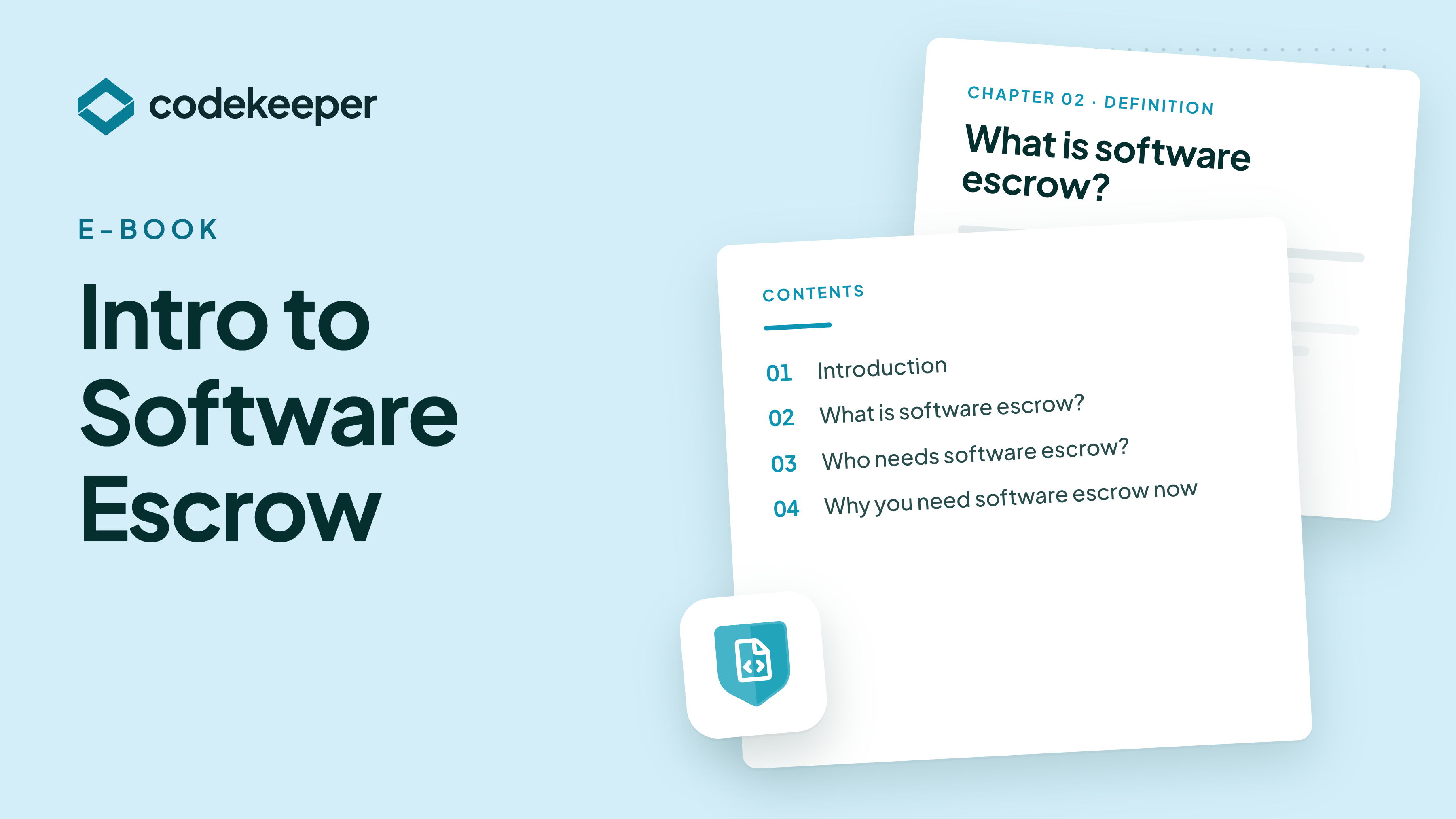
Free guide
Introduction to Software Escrow
What software escrow is, what it protects you from, and how automatic deposits keep it current.
- What a deposit holds and who can claim it
- How release works when a vendor fails
- Setting up deposits that update themselves
Questions
Software escrow, answered.
What's the difference between software escrow and source code escrow?
In most contexts, none. Source code escrow is the most common form of software escrow. Software escrow is the broader term: it also covers documentation, data, build and deployment assets and the other materials needed to maintain the software. What is source code escrow?
Who is the escrow agent?
The neutral party that holds the deposit for both sides, keeps it current and manages a release when a condition is met. Choose one with a clear, auditable process and strong security. Codekeeper is ISO/IEC 27001:2022 certified, with AES-256 encryption at rest and TLS in transit. See the Trust Center.
What happens when a software vendor goes bankrupt?
Insolvency is one of the most common release conditions. The beneficiary asks for a release, we verify the request, and the deposit is released to the beneficiary, who uses it to maintain or rebuild the software. The details depend on the agreement and the law that governs it, so make sure the agreement covers this case clearly.
Can SaaS products be placed in escrow?
Yes. The deposit needs more than code: infrastructure definitions, data exports, credentials and the services the application calls, kept current as the service changes. What is SaaS escrow?
How often should escrow deposits be updated?
As often as the software changes, so the deposit matches the version you run. With Codekeeper, you connect the vendor's repositories once and deposits sync daily.
Is software escrow legally enforceable?
A software escrow agreement is a contract, so how it's enforced depends on how it's drafted and the law that governs it. Our legal team prepares the agreement for the jurisdiction you choose, and your own lawyers can review and mark it up.
How long does it take to set up?
Most of the time goes into agreeing the terms, so setting up escrow while the licence is being negotiated is faster than adding it later. Deposits open once every party has signed.
Who runs the recovery after a release?
With Escrow, you do: the deposit is released to you. With Resilience, the deposit comes to Codekeeper and we run the recovery. Continuity also keeps the live environment paid and switched on for an agreed period while we recover.
Does software escrow cover AI models?
AI systems need a deposit built for them: model versions, prompts, agent definitions, pipelines and workflows. What is AI escrow?
Put escrow in place before you need it.
Book a demo and we'll look at the applications you rely on, the agreement and the right protection for each.