NewResilience, Continuity, the Pro levels and Agentic Verification: from safekeeping to proof you can recover.The new line-up is here.See what's new
Why the six briefings look like this. Production's briefings are "Software Resilience Implementation Worksheets": a six-phase tracker, a step selector with checklists, "What Codekeeper handles for you", a concierge team and resource cards, all written for "software escrow". The six rebuilt briefings share one structure so a team receiving several of them recognises the set straight away:
  • Hero: the role's promise, and the six-phase tracker as the visual. The current phase is marked "Your part" and every other phase links to its briefing, so the hero is also the map of the set.
  • Three numbered topics: what this role needs to know to say yes, in its own language. For decision makers that's the risk, the cost and the proof.
  • "Your steps, and ours": production's checklists, shortened into one table of what you do and what Codekeeper does.
  • The guide band, the FAQ, the people who'll help, links to the other five briefings, and a booking route for this role, then the usual close.
The phase model comes from production, which describes escrow setup. Onboarding should confirm it also fits Resilience Arrangements and Continuity before launch. "Let's build bulletproof software resilience together" is gone from every briefing.
Briefing · Decision makers

The risk, the cost and the proof. Your decision, on one page.

Codekeeper keeps the applications your business can't lose running, whatever happens. This briefing covers what you need to approve it: the risk it covers, what it costs, the proof you'll hold, and who on your team does what next.

  • Trusted by 3,500+ teams
  • ISO/IEC 27001:2022 certified
  • Securing software since 2014
Topic 1 for decision makers: the risk (arc step 1). Named once and calmly, with the three causes the whole site uses. One real event replaces production's probability tables: the JLR figures are from the Cyber Monitoring Centre estimate as reported in October 2025, the same source the homepage uses. All three figures stay flagged until marketing cites the CMC report directly. The guide band further down offers the full JLR case study, so this section and the offer support each other.

1 · The risk

Your business runs on software you don't control.

Every company depends on applications built by someone else. When one fails, you feel it first. A plan agreed in advance turns that moment into a recovery instead of an improvisation.

The vendor stops

Insolvency, an acquisition or a change of strategy can take an application away, along with the people who know how to run it.

An attack takes it down

Ransomware and supply-chain attacks hit live systems and backups alike. Getting back depends on a clean copy kept somewhere else.

Someone asks for your exit plan

Auditors, clients and regulators now ask whether you could leave a supplier and keep running, and what proof you have.

About five weeksJaguar Land Rover's production stop after the 2025 cyber attack
£1.9bnestimated cost to the UK economy
Up to 5,000UK organisations affected through the supply chain

Source: Cyber Monitoring Centre estimate, reported October 2025 (report).

Topic 2: the cost, explained by the job (arc step 3). A decision maker needs the order of magnitude and the logic, not the full grid; the procurement briefing carries the full price list. The lead is the agreed price logic sentence word for word, and the three cards are the same job cards used on Escrow, Resilience and Pricing. Prices are the 6 Oct list (software row). Production's checkout line ("credit card or invoice if your agreement qualifies") is left out: billing terms for the new list aren't confirmed. 16 Oct: Continuity Pro added; the Continuity card names both levels, base Continuity is now everything in Resilience, and Continuity Pro adds proof the deposit builds. 17 Oct: the recovery models are named, as in the launch film (Danny): Self-Run Recovery for Escrow, Managed Recovery for Resilience and Continuity.

2 · The cost

Priced per application, by the job we do.

Escrow means the deposit is released to you and you run the recovery. Resilience costs more because we do the recovery. Continuity costs more again because we also keep the live environment switched on.

Escrow · Escrow Pro

Released to you

Released to you→Self-Run Recovery

Everything you need to be protected. Escrow Pro adds proof the deposit builds, before you need it.

From $199

Resilience · Resilience Pro

Recovered by us

Comes to us→Managed Recovery

If the application fails, the deposit comes to Codekeeper and we bring it back for you.

From $399

Continuity · Continuity Pro

Stays online

Live service kept on+Managed Recovery

Everything in Resilience, plus the live environment kept paid and switched on for an agreed period while we recover. Continuity Pro adds proof the deposit builds.

From $1,449

Software list prices per application per month; SaaS and AI have their own rows. Setup is $499 per arrangement for Escrow and Resilience, $999 for Continuity. Enterprise: talk to us for a quote. See all prices or send your finance team the procurement briefing.

Topic 3: the proof (arc step 4), then the customer voice. The proof ladder is the same on every page: what each document shows and where it comes from. The Recoverability Certificate keeps the agreed line, so nobody reads it as a release right. The three reviews are quoted exactly as on the Book a demo page (names only, as production shows them); they were chosen because they speak about enterprise deployments and the help in choosing, which is what a decision maker weighs. Recheck each quote against the live review source, and add roles and companies only with permission. 16 Oct: Continuity Pro added; base Continuity no longer includes Agentic Verification, so the Recoverability Certificate rung names Continuity Pro.

3 · The proof

Proof beats promises.

Every protection comes with evidence you can put in front of your board, an auditor or a client. The higher the level, the more it proves.

Every protection

Software Resilience Certificate

The deposit is held, and an automated check confirms what's in it, with a vault report.

Proves: it's there.

Escrow Pro · Resilience Pro · Continuity Pro

Recoverability Certificate

AI agents rebuild the deposit in the Codekeeper AI Verification Lab, with no help from the vendor, in hours. It documents the rebuild; release rights come from the agreement.

Proves: it builds. Agentic Verification

Add-on to any plan

Tested Exit Report

Our specialists rebuild by hand in a clean room and test the business functions you nominate, without the original developers.

Proves: you could exit and keep working. Exit Exercise

We worked with Codekeeper as our escrow provider for major enterprise deployments and found them to be extremely professional, responsive, and flexible throughout. I'd highly recommend Codekeeper. They clearly understand the realities of working with growing tech businesses and enterprise customers alike.
Ross Kilshaw
Roger and team thoroughly helped us to understand the nuances of Code Escrow and helped us customize the offering suited to our requirements. Much recommended.
Manu Antony
The demo was very insightful and helped us to understand our best options!
Matthew Healy
Production's five steps and checklists, in one table. Each row is a production step ("Book your initial consultation", "Review your proposal", "Choose your payment method and complete checkout", "Configure your account", "Coordinate internal stakeholders"), with what you do on the left and what Codekeeper does on the right, taken from production's "Our key responsibilities". The checkout row drops the payment methods (card or invoice), because billing terms for the new list aren't confirmed. The parallel due-diligence line is production's ("Your compliance can begin their review process in parallel"). The same table appears on all six briefings.

Your steps, and ours

From first call to a team that's briefed.

You lead the decision. We take care of the questions, the documents and the setup, team by team.
Your part
What Codekeeper does
1 · Book a demo
List the vendors and applications you rely on, any compliance deadlines or client requirements, and who should be involved.
Asks the questions that map your exposure, and shows you the platform and where deposits are kept.
2 · Review the proposal
Share it with the people who approve it. Ask for follow-up calls on legal, compliance or technical questions.
Proposes a protection and level for each application, and answers each stakeholder's questions.
3 · Brief your team
Send each team its briefing. Due diligence can start straight away, alongside the other phases.
Handles the due diligence, legal and technical documentation with each team directly.
4 · Sign up
Sign up online, or ask your account manager for a checkout link set up for your arrangement.
Opens your account and walks your project manager through activation.
The page-specific offer on educational pages. Agreed 7 Oct: on explainers, video guides, magazine articles and role briefings, the mid-page offer is the matching guide instead of the sample evidence pack. Visitors who are still learning convert better on a guide about their question. The hero and closing section still carry Book a demo and Get the sample evidence pack. Case study source on production: the "resources-case-studies-jlr" item on /resources. Before launch: update the guide itself to the October line-up (it still uses the old product names and verification tiers) and connect this form to the HubSpot form that sends it. On the decision-maker briefing the case study backs up topic 1: the JLR figures above come from the same event.
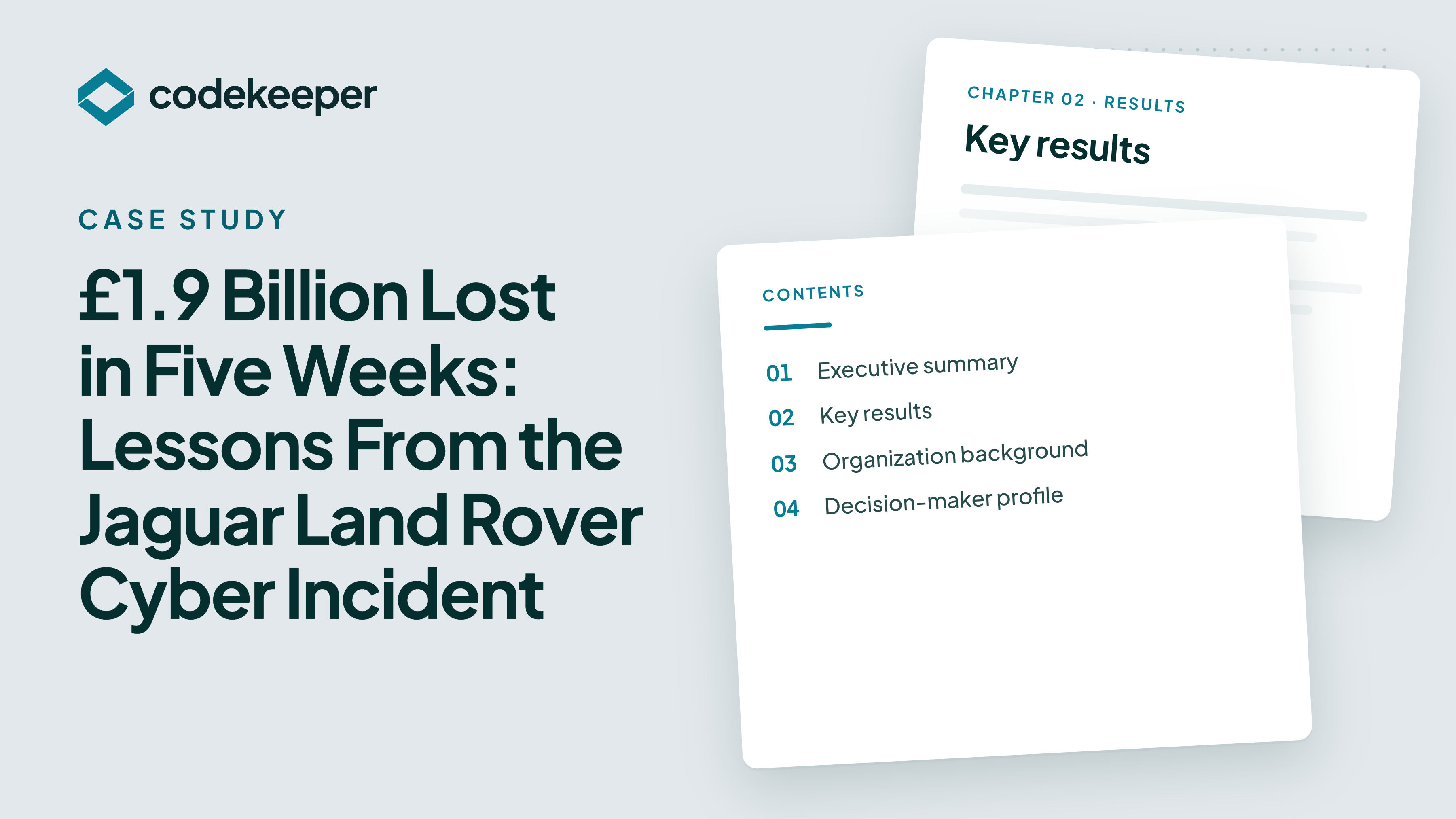
What the Jaguar Land Rover Incident Reveals About Vendor Dependency Risk

Free case study

What the Jaguar Land Rover Incident Reveals About Vendor Dependency Risk

What one cyber incident shows about the risk every software-dependent organisation carries.

  • What happened, and what it cost
  • Where the dependency risk sat
  • What to put in place before it happens to you
Enter your work email.
Enter your company.

Check your inbox.

The case study is on its way. (Example only: this kit sends nothing.)

The questions a decision maker asks before approving. The setup time is production FAQ text ("one to two weeks", "in a day") and stays flagged until onboarding confirms it. The compliance-officer answer is production's note on this page ("If you don't have a compliance officer, you can move straight to sign-up"). The compliance answer uses the agreed disclaimer.

Questions

Before you approve.

Which protection do we need?

Start with what should happen if the application fails. If your team, or a partner you choose, can run the recovery, that's Escrow. If you want Codekeeper to run it, that's Resilience. If the live service also has to stay switched on, that's Continuity. We'll suggest one for each application on the demo.

How long does setup take?

Once your teams are involved, setup usually takes one to two weeks, depending on your internal response times. Legal reviews between parties can take longer, so start early if you're working to a deadline.

We don't have a compliance officer. Is that a problem?

No. Share the other briefings and move straight to sign-up. Our legal team can help with anything that needs legal or compliance input.

We supply the software. Is this for us too?

Yes. Many vendors set up Escrow so their customers' due diligence doesn't stall the deal. A two-party agreement lets you extend protection to any client who asks, and with Escrow Pro you can show them the deposit builds.

Will this make us compliant with DORA or NIS2?

Codekeeper gives you evidence for your file: certificates, run reports, SBOMs and, with an Exit Exercise, a Tested Exit Report. It supports your assessment. Whether it meets a specific requirement is for you and your assessor to decide.

The people, the rest of the set, and the booking route for this role. Production introduces a "concierge team" on every briefing, with photos: Eric (Account Manager, Sales), Robyn (Account Support, Customer Success) and Sam (Tech Support, Customer Success; the photo file is "Sam Hofmeyr"). The photos are production's, by absolute URL. Before launch, confirm with each person that they agree to appear, that the role is current and that the photo is recent. Names are flagged until then. Each card's button goes to the matching booking page: production's "Book a solution briefing" has no page of its own, so Eric's card goes to Book a demo. There's no kit component for a person card; this uses the contact-option card with a round photo (see the report). The decision maker's route is the demo itself.

Your Codekeeper team

Real people, at every phase.

Your team can reach the right person at any point, with questions about their part of the setup.

Eric, account manager at Codekeeper

Account manager · Sales

Eric

Your proposal, the right protection for each application, and pricing questions.

Book a demo
Robyn, account support at Codekeeper

Account support · Customer Success

Robyn

Account setup, supplier onboarding and due diligence requests.

Book a support briefing
Sam, tech support at Codekeeper

Tech support · Customer Success

Sam

Integrations, deposits and rebuilds, with your technical team.

Book a technical briefing

Brief the rest of your team

Start with a demo.

Bring your list of critical applications. We'll suggest a protection and level for each, and send a proposal your team can review.

Book a demo
The same close on every page. The decision-maker briefing closes on the decision itself. Every page ends on the same two actions in the same order: Book a demo, then the sample evidence pack.

Approve it with the facts in front of you.

We'll look at your applications, show you what each protection covers and what it proves, and send a proposal your team can review.

Chat widget goes here. Production runs HubSpot chat in this corner. Keep it on launch: it catches visitors with a quick question who won't book a demo yet. Route it to sales during office hours.