NewResilience, Continuity, the Pro levels and Agentic Verification: from safekeeping to proof you can recover.The new line-up is here.See what's new
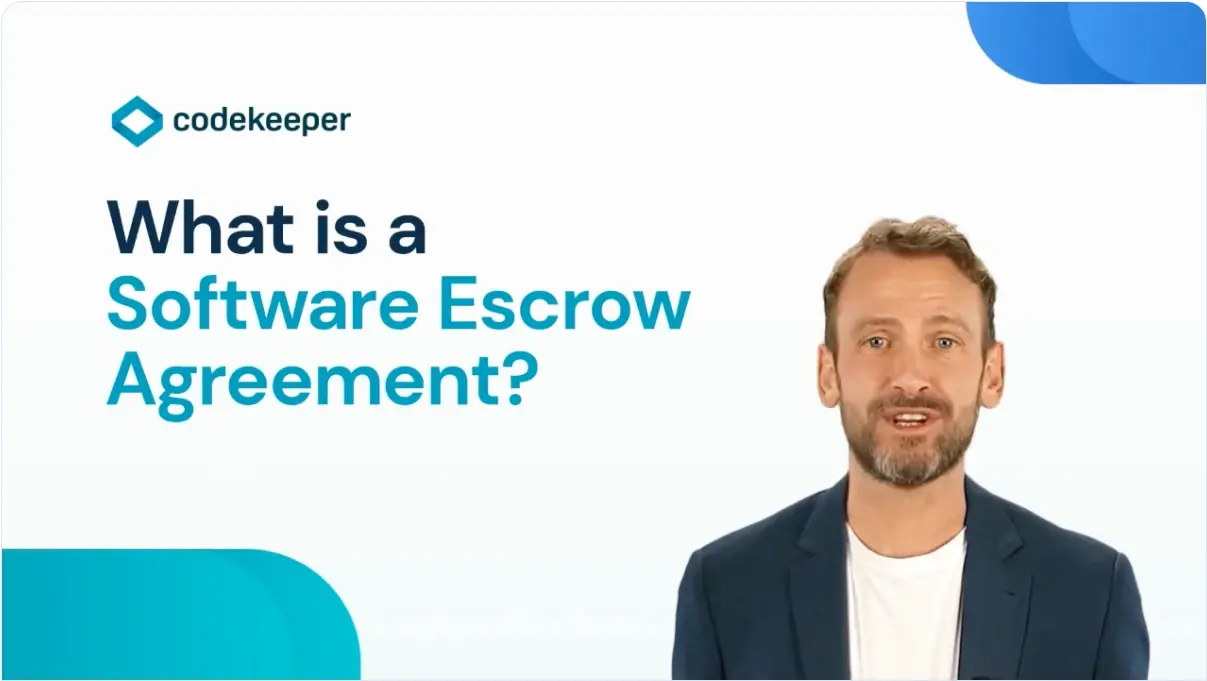
The worked example for the video guides (11 films on production). It replaces /video-guides/what-is-software-escrow and keeps the URL, the search intent and the H1 (sentence case, one mint phrase). The film is production's own YouTube video (ID fWni8qOcWTA, 2 min 9 s on the hub), unchanged.
  • The film loads only when played (the .yt component uses youtube-nocookie), so nothing is requested from YouTube before the visitor presses play.
  • Production's intro text is gone: "Book a free consultation and eliminate your software risk today" and the closing "Let's build bulletproof software resilience together". The sub says what the film covers instead.
  • The film still uses the old model in a few lines. The page says so openly, in its own section below, rather than hiding it. That's the pattern for every video guide until a film is re-cut.
  • Production notes "Video available only in English"; the specs box keeps that.
Production claim kept, flagged: "Trusted by 3,500+ teams" (trust row) is a production figure, kept as agreed; it needs an owner's sign-off before launch (fact-check, 7 Oct).
Video guide · 2 min 9 s

What is software escrow?

How software escrow keeps a way back to the software you depend on, from the agreement to the release, in about two minutes.

  • Trusted by 3,500+ teams
  • ISO/IEC 27001:2022 certified
  • Securing software since 2014
The key points, not the full transcript. The film follows five steps, so the page does too, with the time each one starts. Visitors can skim before they press play, and search engines get the substance. Production's verbatim transcript isn't reproduced, because three of its lines conflict with the brief (see the next section). Keep a full transcript available for accessibility: YouTube captions, or the transcript on the page once the film is re-cut. The key points are a faithful summary of the film; nothing is added.

In the film

Five steps, from agreement to release.

Software you depend on can become unavailable: a company closes, support ends or access is cut off. Software escrow means a neutral third party holds what you'd need to keep going.

Length
2 min 9 s
Language
English
Covers
Escrow: the agreement, the deposit, the release
Made
Before the October 2026 line-up
Good for
Anyone new to escrow, vendor or customer
1

Choose what to protect (0:30)

The developer and the client agree which critical applications need protection, and what to deposit: source code, documentation and data.

2

Sign the agreement (0:43)

Everyone signs an escrow agreement with the neutral party. It sets when and how the deposit is released, for example closure, bankruptcy, discontinued support or a material breach.

3

Make the deposit (1:01)

The developer deposits the code, documentation and data, encrypted and held by the escrow agent.

4

Hold it safely (1:12)

The agent keeps the deposit until something triggers a release.

5

Release to the client (1:19)

The release is checked against the agreement. Then the client receives the deposit and can keep using, maintaining and fixing the software without the original developer.

Say where the film uses the old model. The film is still accurate on the five steps, so it stays. Four things have changed since it was made, and the table names each one with its timestamp, so nobody leaves with a claim the site no longer makes.
  • 1:01 "military-grade vaults": the brief replaces "military-grade" with the actual standard (AES-256 at rest, TLS in transit, ISO/IEC 27001:2022).
  • 1:37 "frameworks like DORA, NIS2, and ISO standards all recognize software escrow as essential protection": no source, and it reads as a compliance claim. Replaced by the agreed disclaimer.
  • 1:55 "eliminating your software risk" and 1:19 "Peace of mind restored": absolutes.
  • Not in the film: who runs the recovery (Escrow, Resilience or Continuity) and the proof ladder. The suggested re-cut adds both in about 20 seconds.

Since this film was made

The steps still hold. A few lines have moved on.

We made this film before the October 2026 line-up. Here's what's different now.

In the film
Now
Security (1:01)
Deposits kept in "military-grade vaults"
AES-256 encryption at rest and TLS in transit. Codekeeper is ISO/IEC 27001:2022 certified
After a release (1:19)
The client receives the deposit and carries on
Escrow releases it to you. With Resilience, we run the recovery. Continuity also keeps the live environment switched on while we recover
Proof
Not covered
Escrow Pro rebuilds the deposit in hours with Agentic Verification and issues a Recoverability Certificate
Regulation (1:37)
"DORA, NIS2, and ISO standards all recognize software escrow as essential protection"
Our evidence supports your assessment. Whether it meets a specific requirement is for you and your assessor to decide
Suggested filmWhat is software escrow? (2026 cut)About 2 min 20 s. Keep the five steps and the animation. Re-voice 1:01 ("encrypted at rest, in an ISO/IEC 27001:2022 certified service") and 1:37 (the disclaimer line). Replace the close with 20 seconds on the three jobs (released to you, recovered by us, kept online) and the proof (a rebuild in hours, a Recoverability Certificate). End on "Keep your software running. Whatever happens."
Step 3, the model: the film explains one job, so show the other two. The same three-job comparison as on the Escrow page, with this film's job outlined. Prices are the 6 Oct list; the price logic sentence is word for word. 16 Oct: Continuity Pro added; base Continuity is now everything in Resilience (not Resilience Pro), and Continuity Pro adds Agentic Verification. 17 Oct: the recovery models are named, as in the launch film (Danny): Self-Run Recovery for Escrow, Managed Recovery for Resilience and Continuity.

Where escrow fits now

Released to you. Recovered by us. Kept online.

Escrow means the deposit is released to you and you run the recovery. Resilience costs more because we do the recovery. Continuity costs more again because we also keep the live environment switched on.

In this film

Escrow

Released to you→Self-Run Recovery

When the agreed conditions are met, the deposit is released to the beneficiary. Explore Escrow

From $199

Recovered by us

Resilience

Comes to us→Managed Recovery

If the application fails, Codekeeper runs the recovery for you. Explore Resilience

From $399

Stays online

Continuity

Live service kept on+Managed Recovery

Everything in Resilience, plus the live environment kept paid and switched on for an agreed period. Continuity Pro adds Agentic Verification. Explore Continuity

From $1,449

Per application per month, software list prices. See all prices

Up next, in the order a beginner learns. The written explainer first (rebuilt in the kit), then the two films production plays next in its "Preparing for recovery" path. Their thumbnails and lengths are production's. Both films predate the line-up too; their pages need the same "since this film was made" section.
The page-specific offer on educational pages. Agreed 7 Oct: on explainers, video guides, magazine articles and role briefings, the mid-page offer is the matching guide instead of the sample evidence pack. Visitors who are still learning convert better on a guide about their question. The hero and closing section still carry Book a demo and Get the sample evidence pack. Guide source on production: the "resources-intro-to-software-escrow" item on /resources. Before launch: update the guide itself to the October line-up (it still uses the old product names and verification tiers) and connect this form to the HubSpot form that sends it. Viewers of an introductory film want the same topic in more depth, which is what the introduction guide covers.
Introduction to Software Escrow

Free guide

Introduction to Software Escrow

What software escrow is, what it protects you from, and how automatic deposits keep it current.

  • What a deposit holds and who can claim it
  • How release works when a vendor fails
  • Setting up deposits that update themselves
Enter your work email.
Enter your company.

Check your inbox.

The guide is on its way. (Example only: this kit sends nothing.)

The same close on every page. A video guide closes by moving from the general film to the visitor's own stack. Every page ends on the same two actions in the same order: Book a demo, then the sample evidence pack.

Seen how escrow works? See it on your applications.

We'll show you what each protection would cover for the software you rely on, and what it would prove.

Chat widget goes here. Production runs HubSpot chat in this corner. Keep it on launch: it catches visitors with a quick question who won't book a demo yet. Route it to sales during office hours.