- Removed: "bulletproof software resilience" (production's meta description and close), "no matter what", "effectively impossible", the Validated, Verified and Certified levels, and the 1986 bankruptcy claim (see the FAQ note).
- The mock shows a complete source code deposit, so "more than code" is visible at once. Fleet Ledger is the fictional application used on the escrow pages.
- Production's hero image (hero-what-is-source-code-escrow.webp) couldn't be opened from the kit to check it, so it isn't used.
What is source code escrow?
Source code escrow is an agreement in which a software vendor deposits its source code, and the materials needed to build it, with a neutral third party. If an agreed release condition is met, the code is released to the customer, who can then maintain the software without the vendor.
- Trusted by 3,500+ teams
- ISO/IEC 27001:2022 certified
- Securing software since 2014
Trusted by 3,500+ teams, from regulated enterprises to fast-growing software vendors








Source code escrow, defined
Source code escrow keeps a vendor's code with a neutral party, under terms agreed by both sides, so the customer has a way back if the vendor can't deliver.
The vendor deposits its source code and the supporting materials with an escrow agent such as Codekeeper. The agent holds the deposit and keeps it current. If the vendor goes out of business, stops maintaining the software or breaches the agreement in a defined way, the agent releases the deposit to the customer, who can then maintain and operate the software independently.
What is source code?
Source code is the human-readable set of instructions developers write to build an application. It sits behind every feature, workflow and integration. Without it, fixing bugs, making changes or moving the software to a new environment isn't practical. The vendor holds it, and without escrow, neither side has a plan for what happens to it if things go wrong.
Source code escrow or software escrow?
In most contexts, the terms mean the same thing. "Source code escrow" puts the code first. "Software escrow" is the broader term: it covers the code and everything a developer needs to maintain the application, from documentation to build scripts and dependencies. The difference matters when you decide what goes into the deposit, because code alone is rarely enough. What is software escrow?
Why a licence isn't enough
Most customers assume their software licence covers them if the vendor runs into trouble. Most vendors assume the licence protects their code. In the situations that matter, neither holds.
A licence grants the right to use the application. It doesn't give the customer the source code. The code is the vendor's most closely guarded asset: years of development and know-how. Handing it over, even to a long-standing customer, is something most vendors resist, and for good reason. But it leaves a gap.
If the vendor fails, nobody maintains the software. The customer can't fix bugs or make changes, and starting over is slow and expensive. The vendor, if it's going through insolvency or an acquisition, has no controlled way to decide what happens to its code.
Escrow closes the gap for both sides:
- The customer gets a written right to the code, held by a neutral party, if an agreed condition is met.
- The vendor keeps its intellectual property private. The code is released only under the agreed conditions, not on request.
- Both know in advance what happens, so nobody has to negotiate it in a crisis.
Depositing code isn't depositing working code
Until someone has tested a deposit, it's an open question whether the code is complete, the build instructions are accurate and every dependency is there. A snapshot from two years ago, or code without the tooling to build it, is protected on paper only.
For software your business relies on, that's worth answering before a release forces the question. And it's worth deciding who would do the recovery: your own team, or someone who does it for you.
Types of agreement
Three ways to structure it.
The right structure depends on the relationship: one customer, many customers, or a vendor that wants escrow ready for anyone who asks.
Three-party (tripartite)
Signed by the vendor, the customer and Codekeeper. The agent's duties are written into a contract the beneficiary signs too, which gives the customer the most formal standing. Common in enterprise and regulated deals.
Two-party (bipartite)
Between the vendor and Codekeeper. Setup is simpler, and protection can extend to any customer who asks. Common when a vendor needs escrow for many clients on the same application.
Multi-party
Names several beneficiaries, each with its own release conditions. Suits shared platforms, partner networks and complex deals.
How it works with Codekeeper
Released to you, or recovered for you.
Add the application to your Codekeeper account, attach the protection that matches what should happen when it fails, then choose the level.
Add the application
The licensed software your business, or your customer, depends on. Prices are per application.
Attach a protection
Escrow releases the deposit to you. Resilience brings the application back for you. Continuity also keeps the live environment on while we recover.
Choose the level
Escrow is everything you need to be protected. Escrow Pro is everything you need to recover: it adds Agentic Verification.
Escrow
Released to you→Self-Run Recovery
Released to you. When an agreed release condition is met, the code and materials are released to the beneficiary, and your team runs the recovery. Explore Escrow
Resilience
Comes to us→Managed Recovery
The deposit comes to Codekeeper, and when the application fails, we bring it back for you. For vendor or in-house applications. Explore Resilience
Continuity
Live environment kept on+Managed Recovery
Everything in Resilience, plus we keep the live environment paid and switched on for an agreed period while we recover. Continuity Pro adds Agentic Verification. Explore Continuity
What a deposit contains
The code, and everything that makes it usable.
A complete deposit holds what a competent developer would need to take over maintenance. Scope it in the agreement, at the start.
Source code
The full development history, including the versions and branches relevant to the customer's version.
Build instructions
Step-by-step instructions for compiling the code into a working application, with the technical documentation.
Database schemas
The structure of the data the application relies on. Without it, the code is there but the application can't be stood up.
Dependencies
The external libraries and components, with their versions. If they aren't documented and available, the application may not compile.
Configuration
Configuration files and environment variables. Often left out of the first scope, and often missed in a recovery.
Deployment and pipelines
The scripts and CI/CD configuration to build, test and deploy. In modern development, they matter as much as the code.
When the code is released
Release conditions are the events that give the beneficiary the right to ask for the deposit. They're defined in the agreement up front, and nothing is released outside them. The most common are:
- The vendor's insolvency or bankruptcy
- The vendor ceasing to trade
- A failure to provide agreed maintenance or support, after formal written notice
- A material breach of the licence
- A change of ownership after which support obligations aren't honoured
- Persistent, documented failure to meet agreed service levels
Others can be negotiated, such as the departure of people essential to maintaining the software, or the vendor failing to keep the deposit current.
How a release works
- The beneficiary asks for a release and says which condition has been met.
- We verify the request before anything becomes accessible: a legal review, verification of the release condition and authentication of the beneficiary. The depositor is notified, and the agreement sets how a dispute is handled.
- Once the release conditions are verified, the beneficiary typically has access within two to three hours.
Rights after a release
A release doesn't transfer ownership of the source code or create new intellectual property rights. The customer receives the right to use the code to maintain and operate the application, as the licence and the agreement define. The vendor keeps its intellectual property, and the agreement should say so clearly.
The proof
Proof the code is there, and that it builds.
For software your business relies on, find out whether the deposit works before a release forces the question.
Software Resilience Certificate
The deposit is held, and an automated check confirms what's in it, with a vault report.
Proves: it's there.
Recoverability Certificate
AI agents rebuild the deposit in the Codekeeper AI Verification Lab, with no help from the vendor, in hours. You also get build steps, an SBOM and an Exit workbook.
Proves: it builds. Agentic Verification
Tested Exit Report
Our specialists rebuild by hand in a clean room and test the business functions you nominate, without the original developers.
Proves: you could exit and keep working. Exit Exercise
Four rebuilds a year are included with Escrow Pro, on supported technology stacks. The Recoverability Certificate documents the rebuild. It doesn't grant release rights: those come from the agreement.
What it costs
Priced per application, by the job we do.
Per software application, per month. Hosted or AI application? See the SaaS and AI rows.
Escrow
Everything you need to be protected.
Custody, release under the Escrow Agreement, an automated check and a Software Resilience Certificate.
$199per application per month
Explore EscrowEscrow Pro
Everything you need to recover.
Escrow plus Agentic Verification: proof the deposit builds, and a Recoverability Certificate.
$449per application per month
Explore Escrow ProResilience
We recover it.
The deposit comes to Codekeeper. If the application fails, we run the recovery.
$399per application per month
Explore ResilienceResilience Pro
Proven before we need it.
Resilience plus Agentic Verification, so recovery starts from a deposit we know builds.
$649per application per month
Explore Resilience ProContinuity
Full continuity.
Everything in Resilience, plus the live environment kept paid and switched on for an agreed period while we recover.
$1,449per application per month
Explore ContinuityContinuity Pro
Full continuity, proven in advance.
Continuity plus Agentic Verification, so recovery starts from a deposit we know builds.
$1,699per application per month
Explore Continuity ProEscrow means the deposit is released to you and you run the recovery. Resilience costs more because we do the recovery. Continuity costs more again because we also keep the live environment switched on. At every protection, Pro adds Agentic Verification. Setup is $499 per arrangement, or $999 for Continuity and Continuity Pro. One claimant is included; more are an add-on. Cost coverage is quoted for Resilience and Continuity. Enterprise: talk to us.
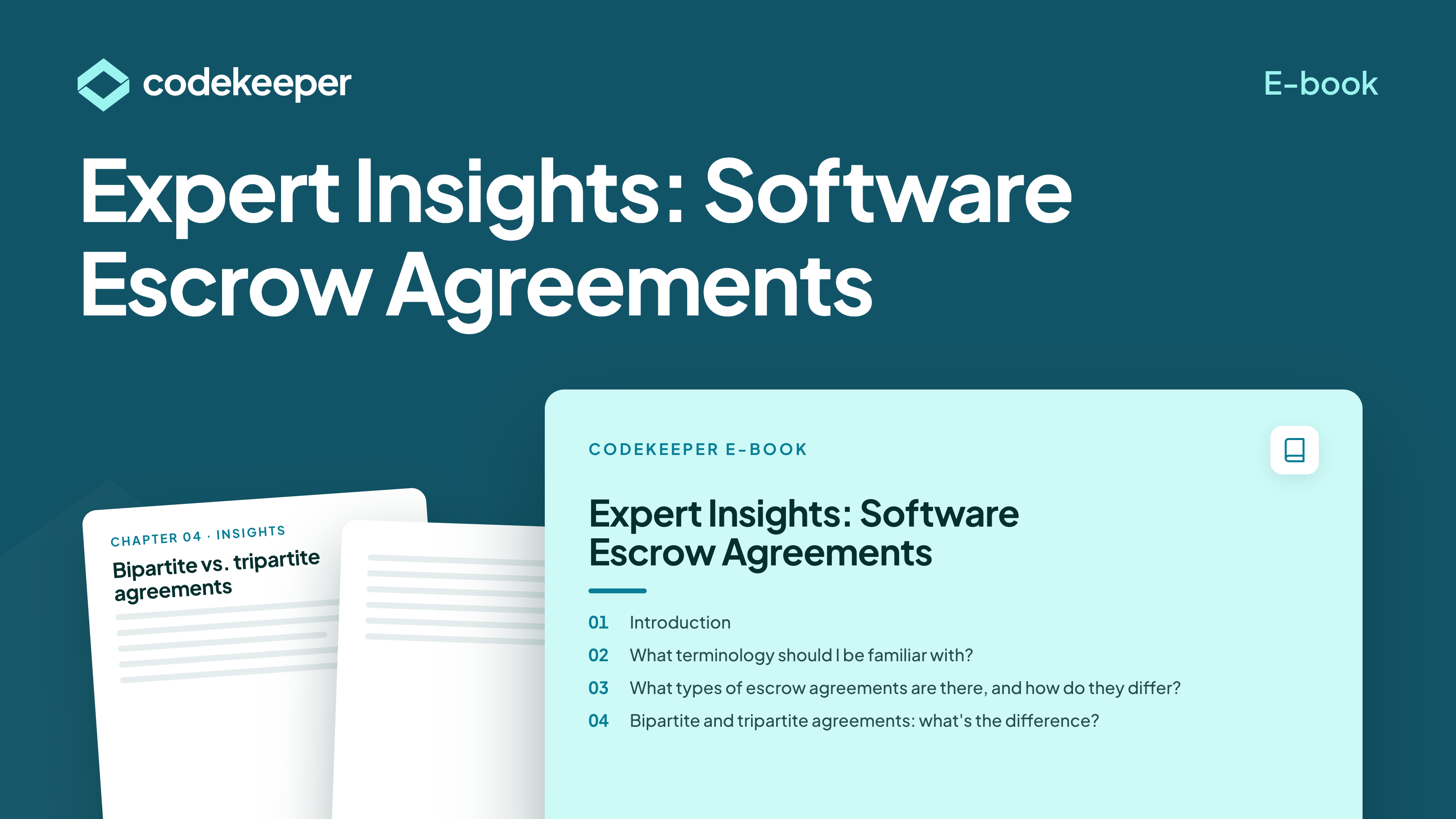
Free guide
Expert Insights: Software Escrow Agreements
The terms in an escrow agreement, what goes into a deposit and how release events work.
- The terminology, explained plainly
- What a deposit should contain
- How release events are triggered and verified
Questions
Source code escrow, answered.
Who owns the source code after a release?
The vendor. Escrow doesn't transfer ownership. The customer gains the right to use the code to maintain and operate the application, as the licence and the agreement define, and the vendor's intellectual property rights stay intact.
Is source code escrow legally enforceable?
An escrow agreement is a contract, so how it's enforced depends on how it's drafted and the law that governs it. Our legal team prepares the agreement for the jurisdiction you choose, and your lawyers can review and mark it up. How the agreement works
How often should source code deposits be updated?
Whenever the software changes, so the deposit matches the version in use. With Codekeeper, you connect the repositories once and deposits sync daily.
Does source code escrow cover SaaS applications?
Not fully. For a hosted application, the deposit also needs infrastructure definitions, data exports, credentials and third-party services, not just the code. What is SaaS escrow?
How quickly can it be set up?
Most of the time goes into agreeing the terms. Setting up escrow alongside the licence is faster than adding it later. Deposits open once every party has signed.
Are we the depositor or the beneficiary?
If you supply the software, you're usually the depositor. If you rely on it, you're usually the beneficiary. Not sure? We'll work it out with you on a demo.
Agree the terms before you need them.
Book a demo and we'll walk through the agreement, the deposit and the right protection for your software.